AI visibility, measured
Your customers ask ChatGPT now. It has never heard of you.
We fix what AI assistants read about your business, then ask Claude again so you can see what changed.
See if AI names youWhat is GEO?
Scroll to see how this starts
This is how customers ask now, in every industry
- The market leader
- The established name
- The newcomer
We turn that moment into a number
The visibility score
It counts how often a business gets named when we put twelve of its buyers' real questions to an AI assistant with live web search. The panel is fixed and every answer is dated, because the answers change from one month to the next.
In this example, the business is named in 5 of its 12 buyer questions: a score of 42.
Where things stand
This is already happening, and you can measure it.
Illustrative example: how a visibility score moves across six months of monitoring
900M people use ChatGPT every week.
OpenAI, Feb 202668% of Google searches end without anyone clicking through to a website.
SparkToro / Similarweb, Jun 2026-58% is how far click-through falls for the top organic result once an AI Overview appears above it.
Ahrefs, Feb 2026So when the AI does recommend someone, who is it?
Illustrative example: how many of twelve buyer questions named each business in one market
What we actually do
We get you in.
We find the gap
The visibility check tells you which customer questions you're missing from, and which competitors get named in your place.
We close it
Then we get the AI assistants to know who you are and to have a reason to point people at you. That's the part we handle, so you don't need to learn a new discipline or rebuild your site.
We prove it
Once your fixes are live, the same questions are asked again: in how many you were named, and which way it moved. With monitoring, that number arrives every month.
Why now
The fight for page one on Google took nearly three decades. In AI answers, it has barely started.
There's no page two.
See where you actually stand.
In 48 hours you'll know which customer questions you're missing from. It's free, and nobody will call you to sell you anything. If you want us to close the gap after that, we will.
Where to start
One path, three stages.
Start here
AI visibility audit
A list of the customer questions you're missing from and the competitors named in your place, with what we'd fix first.
The work
GEO optimization
Fixed-scope work, set by the audit, that gives AI assistants what they need to know who you are and a reason to recommend you. Once it is live, the same questions are asked again.
The proof
Monitoring & reporting
The same twelve buyer questions put to Claude every month: your score, and every question set beside last month's.
Visible, half-visible, invisible
Three ways an AI talks about you
Most businesses sit somewhere in the middle. That middle is the part we work on.
| How an assistant answered | What that means for you |
|---|---|
| Recommended ChatGPT · “who would you recommend?” | The AI names you and can say why. That reason is what does the selling. |
| Just mentioned Claude · “which providers are there?” | You show up on the list, but nothing in the answer tells anyone to pick you. |
| Invisible Perplexity · “what's the best choice?” | Someone else gets the recommendation. You never see the question, so you never find out it happened. |
Quick answers
The questions we get asked most
What is GEO, in plain terms?
GEO is short for generative engine optimization: the work of becoming one of the businesses an AI assistant names when someone asks it for a supplier. A buyer who would once have opened a search engine now puts the question to ChatGPT or Perplexity and acts on the two or three names that come back. GEO is what puts a business into that set and keeps it there.
We already do SEO. Is this the same work?
No, though they share a foundation. SEO competes for a position in a list of links. GEO competes to be one of the two or three businesses an assistant names inside a written answer, where there is no second page to fall back to. A fast, crawlable site helps both; after that they diverge, because an assistant needs facts about your business it can attribute, quote and verify, not a page that outranks a directory.
Which AI assistant do you measure?
Claude, made by Anthropic, with live web search on, the way a buyer would use it. ChatGPT, Gemini and Perplexity read their own indexes and can answer differently, so we never report Claude's answer as theirs, and the fixes we make are for the pages all four read. The panel of twelve buyer questions is built for your trade and your location and scored the same way each time, so the figure after the fixes, or in the fourth month of monitoring, is comparable to the first rather than being a fresh opinion.
How would we see whether it is working?
You watch the same number we do. Before any work starts, a fixed panel of the questions your buyers actually ask goes to the assistant, and we record how often you are named. The panel does not change after that, so every re-run, once the fixes are live and each month with monitoring, is comparable to the first rather than a fresh opinion. The number rises, holds, or does not, and you can see which without taking our word for it.
What proof is there that any of this matters?
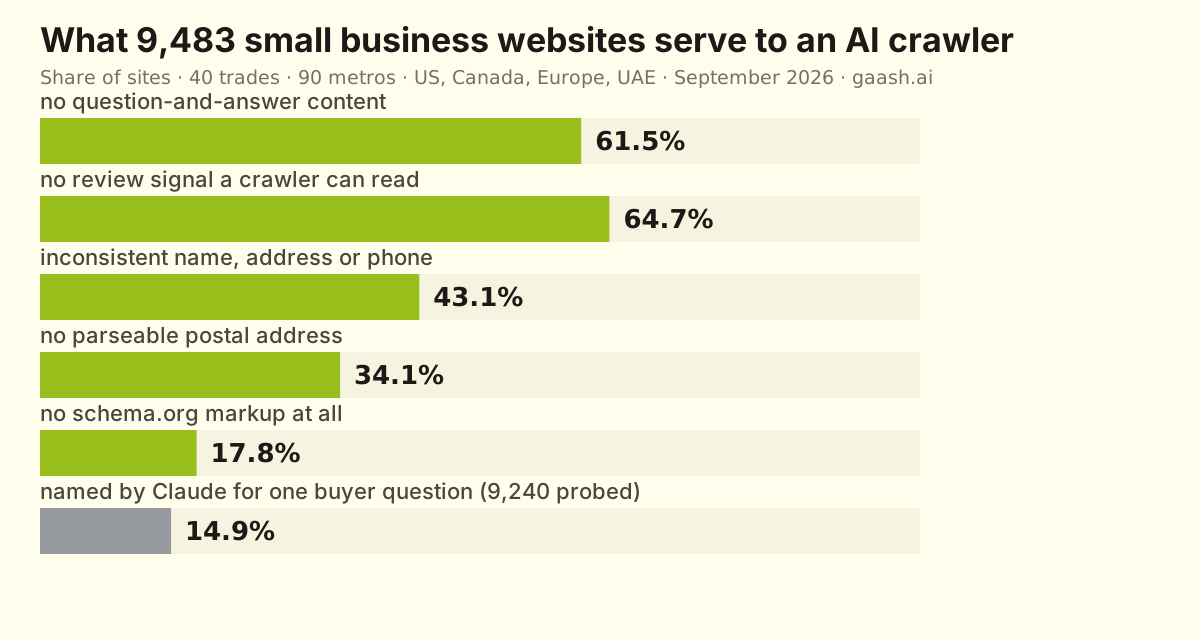
Our own, published with the method attached. We audited 9,483 small business websites across forty trades and ninety metros and found 61.5% had no question-and-answer content an assistant could quote and 43.1% could not be pinned to one name, address and phone number. Then we put one real buyer question for each of 9,240 of those businesses to Claude, with web retrieval on: 14.9% were named. Of every name it gave, 99.4% were real businesses rather than directories. That is a Claude number, one question each, one day.
How long before anything moves?
Four to eight weeks is typical before the panel shows any movement, and about three months before a change is large enough to argue with. None of it is fast. What you get in exchange is that it is equally slow to undo: a business that has become the named answer takes real work to displace.
Does this mean rebuilding our site?
Almost never. Most of what an assistant needs is already on the site and simply cannot be read or attributed — facts scattered across three pages, answers with no question attached, a company name that appears in four spellings. We fix what is there, write the few pages that genuinely do not exist, and work on being cited elsewhere. A rebuild is a separate decision, and we will say so if it is the honest answer.
What will this cost us?
The visibility check is free. The audit is $490 one-time and is credited in full against optimization if you go ahead. Optimization starts at $1,900 for a fixed scope you approve first, and monitoring is $290 a month, cancellable monthly. There is no long contract on any of it.
You may as well find out.
The check takes 48 hours and costs nothing. After that you know what you're missing, and you can decide whether it's worth doing something about.